
SEC Statement on Tokenized Securities, and Maturing Stablecoin Infra [FP Weekly 6]


: : [Issue] SEC Statement on Tokenized Securities: Code Is Not Law, Law Is Law
Written by Eren

https://4pillars.io/en/issues/securitize-code-is-not-law-law-is-law
The SEC’s statement on tokenized securities signals two things clearly: first, tokenized securities are recognized as an extension of formal securities market infrastructure; second, they fall squarely under the SEC’s regulatory jurisdiction.
The ETF Rule, fully implemented in 2020, marked a turning point by defining ETFs as a standardized product category and unlocking large-scale institutional capital inflows. For tokenized securities to scale, similar institutional standardization is required, particularly around legal ownership, investor rights, regulatory compliance, and predictable clearing and redemption mechanisms.
Securitize is positioning itself to become a regulation-first tokenization platform through a clear strategy: (i) a direct issuance model designed for SEC compliance, (ii) the recruitment of senior leadership with deep ETF market experience, and (iii) a transition into a publicly listed company.
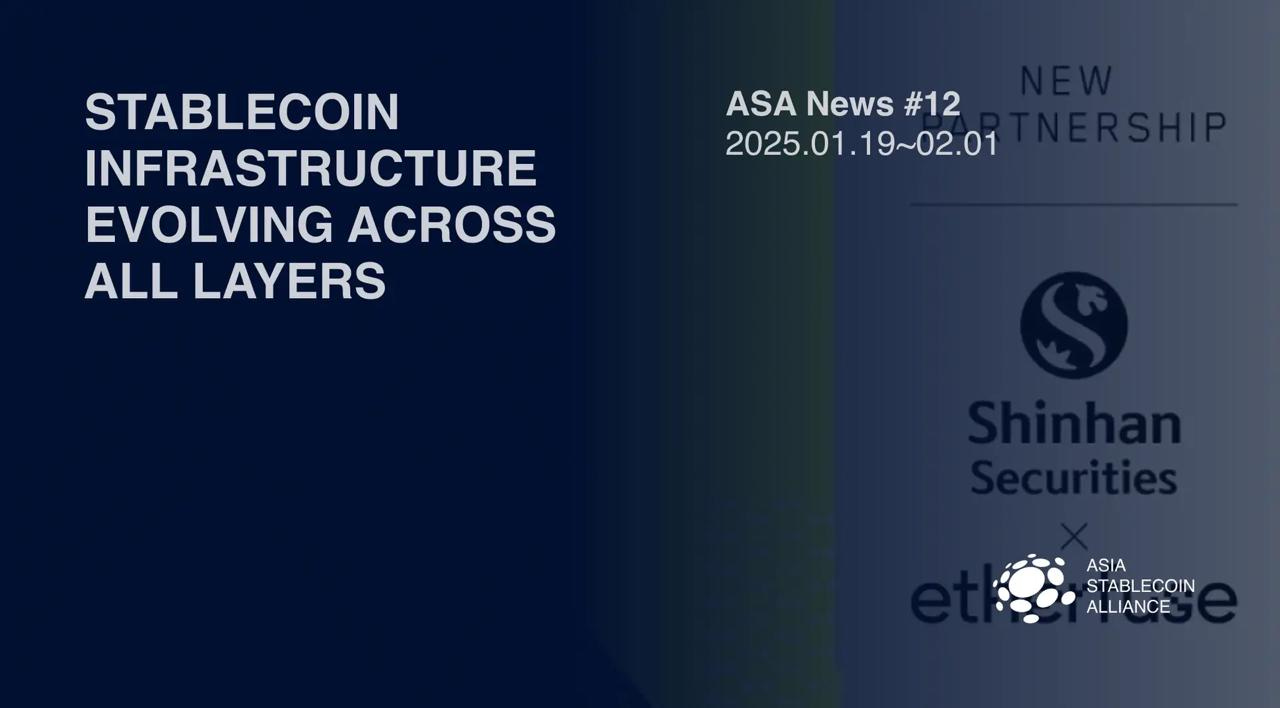
: : [Issue] Stablecoin Infrastructure Evolving Across All Layers (ASA News #12)
Written by ASA, Moyed
https://4pillars.io/en/issues/stablecoin-infrastructure-evolving-across-all-layers
[News #1] Blockchain Infrastructure Collaboration for Efficient Cross-Border Access to Korean Government Bonds
✍️ Access first, utility second, and operations as the real differentiator (by Moyed)
[News #2] SMBC Card and MynaWallet Begin JPYC Tap-to-Pay PoC in Fukuoka
✍️ ‘National ID × Stablecoin’: Japan’s Vision for Financially Inclusive Payment Infrastructure (by Moyed)
[News #3] Hashed Open Finance Releases Litepaper for Compliance-Friendly Korean Blockchain
✍️ Korea’s Stablecoin Chain Is Coming, and Asia Needs This (by Heechang)
: : [Issue] Arcium: Blockchains’ Missing Privacy Layer
Written by C4lvin

https://4pillars.io/en/issues/arcium-blockchains-missing-privacy-layer
Privacy is a fundamental right, not an optional feature. Under centralized data management structures, individuals have no say in how their data is protected. Moreover, existing blockchain-based privacy protocols fall short of being a fundamental solution due to limitations such as single-chain dependency and a narrow scope of computation.
Arcium is a computation layer built on Multi-Party Computation that simultaneously achieves the conditions required of a general-purpose privacy protocol: privacy preservation during computation, collusion resistance, scalability through parallelized execution, and chain-agnosticism. In doing so, it presents a comprehensive answer to the shortcomings of today’s privacy landscape.
Arcium is currently building real-world, MPC-powered privacy-preserving applications centered around the Solana ecosystem, including C-SPL confidential tokens, on-chain dark pools, Umbra, and private AI. Its ultimate goal is to establish privacy as a foundational layer of infrastructure for every blockchain.
: : [Article] Monthly EIP - Jan 2026 (ft. Spotlight on the Institutional ETH Yield Pipeline)
Written by Jay
https://4pillars.io/en/articles/monthly-eip-jan-2026
In January, the EIP landscape exhibited a broadly distributed pattern of newly proposed and status-upgraded ERCs, with notable concentration in token extensions, contract architecture improvements, and messaging-related standards. This pattern appears to reflect the combined effects of increasing institutional attention and capital inflows, alongside a recovery in developer momentum following the Fusaka upgrade in December.
At the network layer, EIPs directly associated with the Fusaka upgrade demonstrated tangible progress, whereas rollup improvement proposals (RIPs) showed comparatively limited movement during the same period.
In parallel, as Ethereum continues to be repositioned as a more institution-compatible infrastructure, a particularly salient trend is the growing set of initiatives aimed at constructing institutional-grade onchain yield pipelines, with staking increasingly serving as the primary entry point.
: : [Article] $PUMP Thesis: The Casino in January
Written by Ponyo

https://4pillars.io/en/articles/pump-thesis-the-casino-in-january
pump.fun generates $567M in annualized revenue at a 1.36x P/E — on a platform doing $1.29B in fees, more than every DeFi protocol except Hyperliquid. Hyperliquid trades at 9.67x, Uniswap at 103x.
When users halved during the 2025 trough, fees per user doubled. Thirteen consecutive months above $1M/day through the worst macro since 2022, $1.52B in ICO dilution, and active litigation. That’s addiction infrastructure, not tourism.
Buybacks absorb ~2x all new token supply at current prices, and that ratio improves when team unlocks begin in August — Phase 2 emissions (~9.2B PUMP/month) are actually lower than Phase 1 (~10B).
The downside requires revenue to fall below where it’s ever been. The upside only requires the multiple to normalize. At a garbage-tier 4x on current revenue, FDV is $2.2B, a 3x from here.
This Week’s Research
[Article]
[Issue]
SEC Statement on Tokenized Securities: Code Is Not Law, Law Is Law
Stablecoin Infrastructure Evolving Across All Layers (ASA News #12)
[Comment]